AVAILABILITY OF AREAS: EVOLUTION OF THE LEGAL FRAMEWORK UNTIL THE ADVENT OF THE PUBLIC OFFER SYSTEM AND ELECTRONIC AUCTION BY THE NATIONAL MINING AGENCY
DOI:
https://doi.org/10.36524/ric.v12i1.3258Keywords:
mining law, ANM, mineral governance, area auctionAbstract
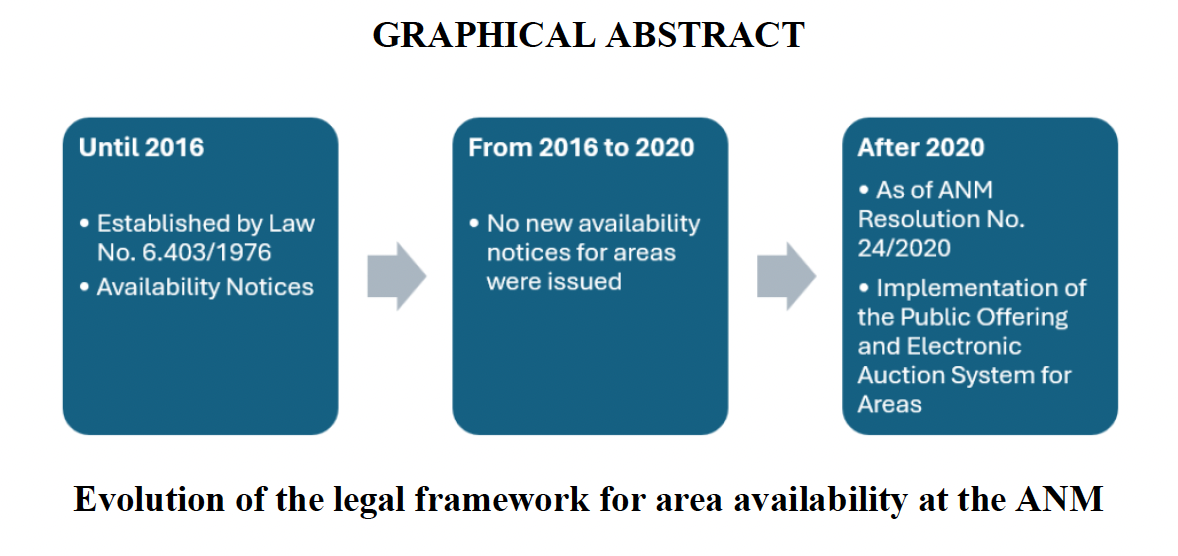
This study analyzes the regulatory evolution of the area availability procedure in the Brazilian mining sector, focusing on the changes introduced by Decree No. 9,406/2018, ANM Resolution No. 24/2020, and Ordinance No. 155/2016. The previous model, based on the best technical proposal, proved to be inefficient and prone to subjective decisions, leading to idle areas and legal uncertainty for the mining sector. With the creation of the National Mining Agency (ANM) and the implementation of an electronic system for public offering and area auction, greater efficiency and competitiveness in access to mineral resources were sought. The introduction of objective selection criteria, such as the highest bid value, represented a significant step toward democratizing access to mining areas and attracting new investments. The study concludes that the new availability model represents a paradigmatic shift in the sector, requiring continuous monitoring and regulatory improvement to ensure its effectiveness and compliance with modern mineral governance principles.
Downloads
Published
Issue
Section
License
Copyright (c) 2026 Revista Ifes Ciência

This work is licensed under a Creative Commons Attribution-NonCommercial-NoDerivatives 4.0 International License.
Autores que publicam nesta revista concordam com os seguintes termos:
- Autores mantém os direitos autorais e concedem à revista o direito de primeira publicação, com o trabalho simultaneamente licenciado sob a Licença Creative Commons Attribution que permite o compartilhamento do trabalho com reconhecimento da autoria e publicação inicial nesta revista.
b. Autores têm permissão e são estimulados a publicar e distribuir seu trabalho online (ex.: em repositórios institucionais ou na sua página pessoal) a qualquer ponto antes ou durante o processo editorial, já que isso pode gerar alterações produtivas, bem como aumentar o impacto e a citação do trabalho publicado (Veja O Efeito do Acesso Livre).